
Scania Explores Lignin-Based Plastics to Drive Sustainable Mobility
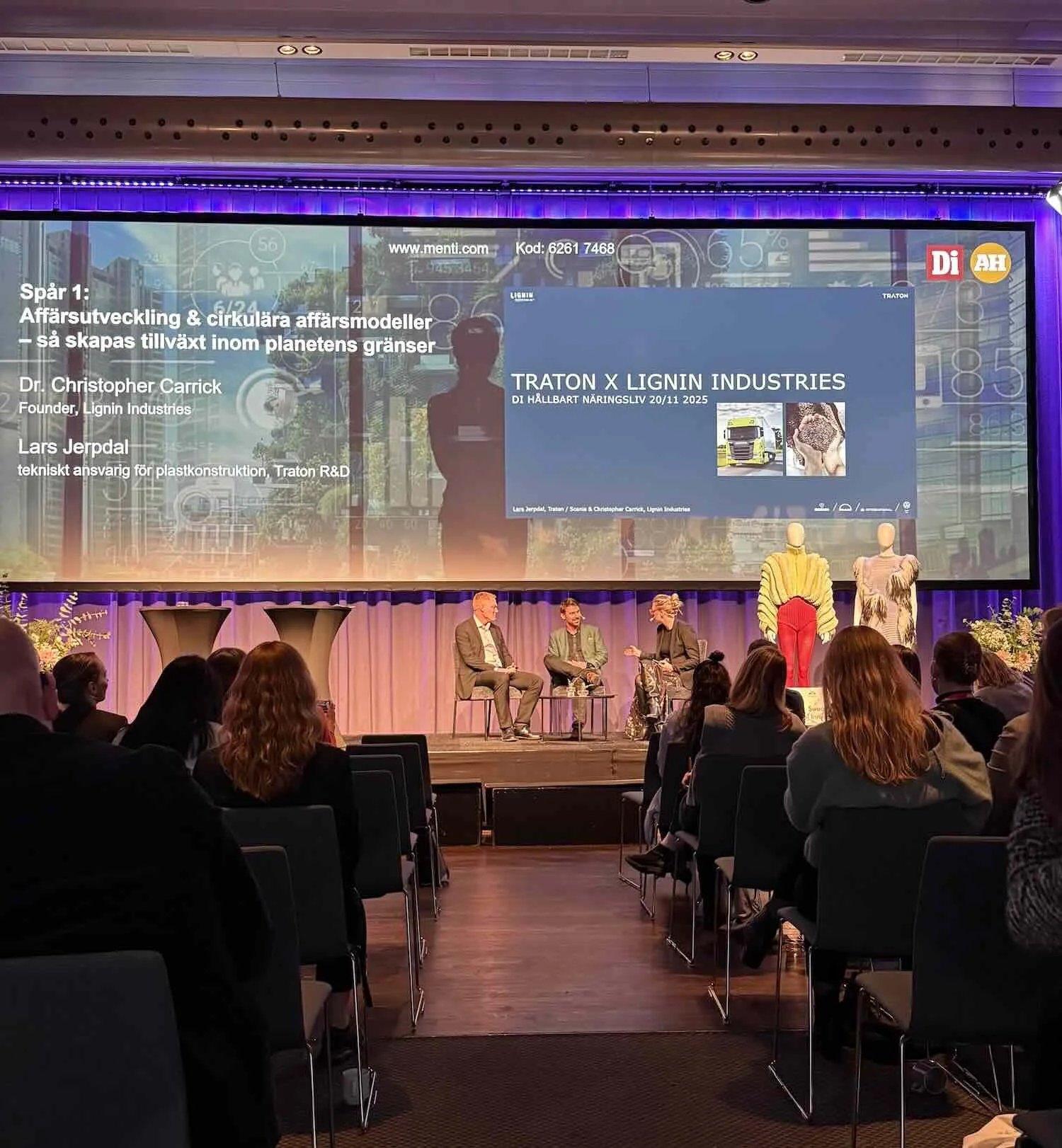
Driving Sustainability: Traton (Scania) Explores Lignin-Based Plastics
At the conference Hållbart Näringsliv (Sustainable Business), organised by Dagens Industri and Aktuell Hållbarhet on November 20, Lars Jerpdal, Traton (Scania) and Christopher Carrick, founder of Lignin Industries, shared insights on how lignin-based plastics can help transform the automotive industry.
On stage in Stockholm, Lars and Christopher discussed how the automotive sector can reduce its climate impact through innovative material solutions. One promising area is lignin, a bio-based secondary raw material that can replace part of the fossil-based plastics in vehicles.
“If we look at Lignin Industries, we could replace 5–10% of the fossil-based plastic with lignin-based bioplastic,” Lars explained. Considering that a single vehicle can contain up to 500 kg of plastic, this represents a significant opportunity. Lignin Industries’ thermoplastics Renol® works as a drop-in solution, meaning it can be integrated into existing processes without major changes.
Furthermore, Lars emphasized that new materials must fit strategically. “It’s not like we jump on every idea we come across. It has to fit with our project portfolio. It needs to hold up all the way—not just technically, but also from a business perspective—and it has to be scalable.” When tested with technologies (Ku-Fizz®) that make plastic components lighter, Renol® proved to be an enabler, allowing Scania to use a smaller amount of plastics. The benefits go beyond material substitution: “This has meant that, process-wise, we’re not just adding a certain amount of biomaterial, but we can also make the components lighter and use less energy in the production process. There have been several advantages to using lignin in production.”
Cost competitiveness depends on scaling and for advanced plastics, cost neutrality is easier to achieve. “If we can use Renol® for our foaming technology (Ku-Fizz®), where we use a smaller amount of plastic and lignin acts as an enabler, then we could even end up with a cheaper product.”